





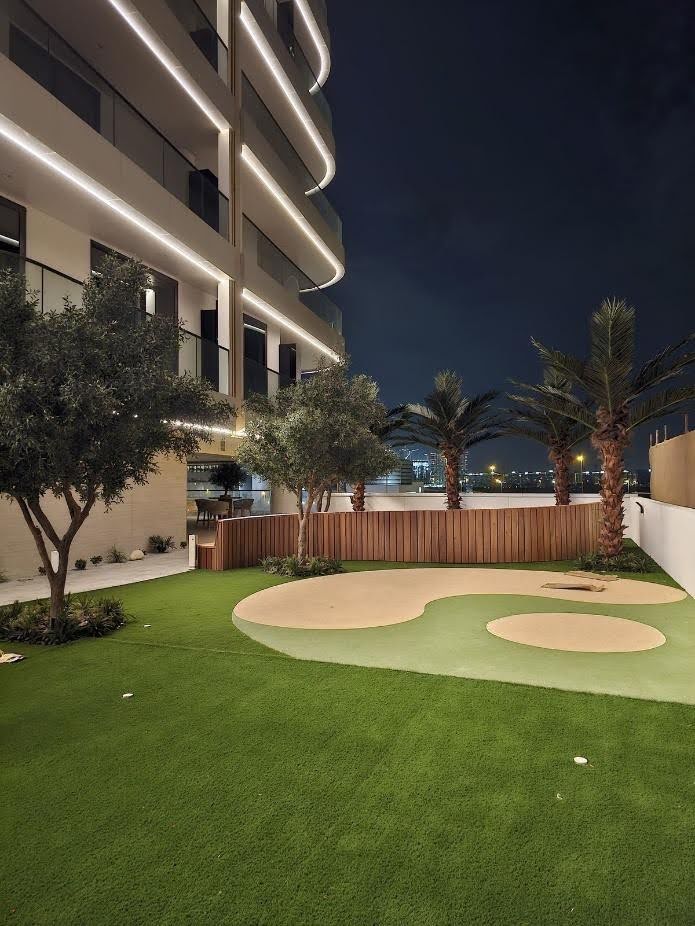
In Business Bay, outdoor spaces are part of the residential experience. At a Marasi Drive residence, Shajara installed bespoke artificial palm and olive trees to bring height, texture and contrasting forms of greenery into a shared landscaped area. The palms create a tropical silhouette, while the olive trees add a quieter Mediterranean character. Together, they complement the building’s contemporary architecture and help give the outdoor space a distinct identity.
Artificial palms bring a distinctive tropical atmosphere to residential landscaping. At Marasi Drive, the palms stand along the outer edge of the landscaped space, adding vertical interest while leaving the central area open. Their sculptural trunks and spreading fronds contrast with the lower, more irregular forms of the olive trees.
For a comparable entrance, terrace or shared outdoor area, palm height and canopy spread should be planned around the architecture, sightlines and circulation space. A tree that looks proportionate in an open courtyard may feel oversized near a narrow walkway. Bespoke artificial tree design allows the trunk appearance, foliage density and overall scale to respond to the site rather than relying on one standard catalogue size.
Olive trees introduce a different character to the same landscape. Their sculptural trunks, finer branches and muted foliage sit comfortably with the residence’s light finishes and contemporary exterior. The olive trees frame the area beside the building, while the palms add height along the far edge.
The pairing gives the outdoor space visual variety without making every planting zone look identical. For another residence, tree selection should follow the planned use of each area and the views from surrounding rooms and seating. A smaller olive silhouette may suit a courtyard or lounge edge where a broad palm canopy would crowd the space.
For more detail on choosing materials and placement for exposed outdoor settings, see the guide to UV-resistant artificial olive trees in Dubai. The right outdoor specification depends on the conditions at each site.
Outdoor installations in Dubai require attention to sunlight, heat, dust and wind. Suitable foliage, trunk and branch materials, finishes, bases and fixing methods should be selected for the exact position of each tree. Exposure can differ between a sheltered entrance, an open podium and a poolside edge, even within one development.
For a similar project, ask about UV-resistant foliage, the suitability of the trunk and branch finishes, and how the trees will be secured. Product ratings, warranties and fixing details should be confirmed for the selected trees and the conditions at their intended locations.
Bespoke trees can be developed around a project’s dimensions and design language. Height, canopy spread, trunk form, foliage tone, planter finish and decorative ground treatment all influence how an installation relates to the surrounding building and outdoor furniture.
At Marasi Drive, palms and olive trees create separate visual rhythms within one landscaped setting. For future residential projects, designers should settle tree positions alongside paving, planters, lighting, pedestrian routes and maintenance access. This helps the greenery feel integrated into the space instead of added after the layout is complete.
The Marasi Drive installation shows how artificial trees can shape the experience of a residential outdoor area. The palms provide a resort-like presence; the olive trees bring a more restrained Mediterranean note. Both add greenery without the irrigation and pruning required by living trees, although periodic cleaning and inspection still matter. The comparison of artificial and natural trees in Dubai explains those care differences in more detail.
For developers, designers and property managers planning a similar space, the useful starting points are a site plan, proposed tree locations and the exposure conditions at each position. To discuss a bespoke installation, contact Shajara with the drawings, dimensions and preferred tree styles.
They create different shapes and moods within the same design: palms add height and a tropical silhouette, while olive trees bring a more restrained form. Their placement should follow the architecture and use of each outdoor zone.
They can be when the selected products and installation are specified for the site’s sunlight, heat, dust and wind exposure. Ask for product and fixing details for the exact location rather than assuming every artificial tree is suitable outdoors.
A bespoke project can plan tree height, canopy spread, trunk appearance, foliage density and planter finish around the space. Final options depend on the supplier’s design and technical specification.
They do not need watering or pruning, but they should be cleaned and inspected periodically. The care method and frequency depend on the materials and exposure of each installation.


